

Technical Note 7 –
Temperature and UV Resistance
Applications
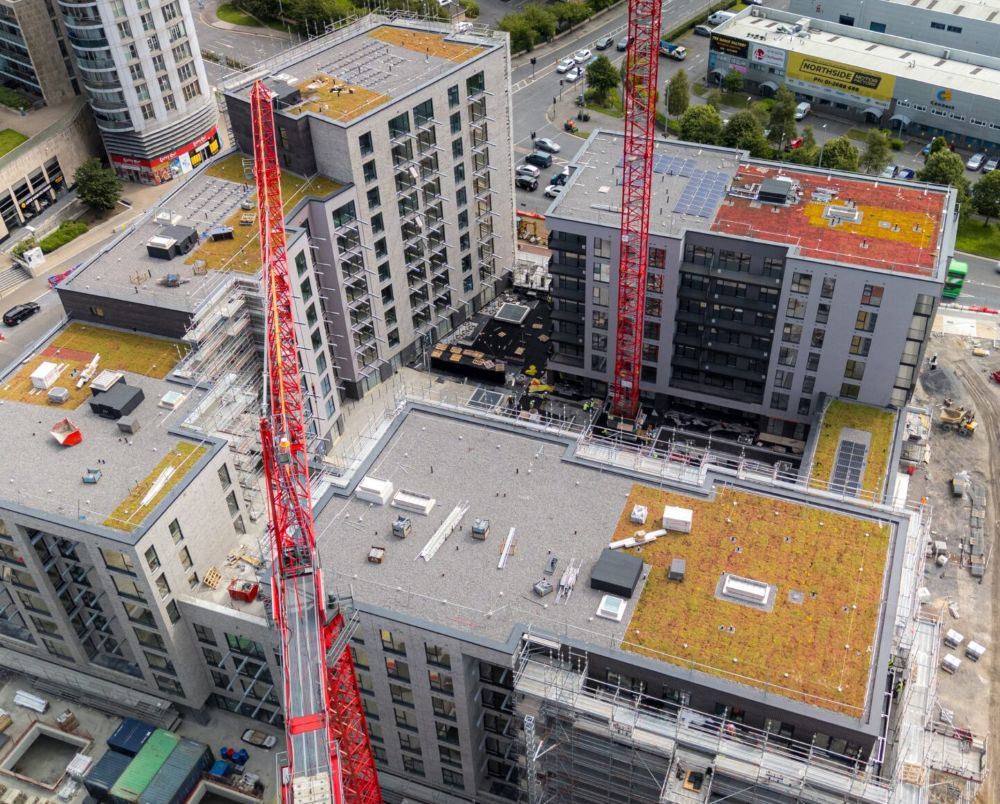
ProctorGeo EnkaVent represents a breakthrough in roofing underlayment technology. It is a three-dimensional multi-use mat, made of continuous nylon filaments fused at their intersections. The product can be used in metal and ballasted roofing applications where spacing of the roof will provide the ventilation and drainage needed for a long service life. The nylon filaments do not fail under the load of the roof and the rigors of the construction environment, including construction foot traffic. The space between the roof membrane/weather barrier underlayment and the ballast/metal roof will allow moisture to flow away or evaporate, resulting in an increased lifetime of the roof and the roof structure.
Exceptional Durability
Polyamide (PA6) spacer mats are known for their high tensile strength and durability, making them suitable for long-term use in building applications. PP spacer mats may become brittle over time when used outside the recommended UV exposure and temperature conditions. Below is a photo of our previous HC9 product made from PP, that was left stored outdoors in Australia for an extended period and had to be replaced.
Temperature Resilience
The ProctorGeo EnkaVent operational temperature range is conservatively declared as -30°C to +100°C. This outperforms PP products which may deform under extended exposure above 80°C. In Australia & New Zealand, the temperature of unventilated dark colour roof sheets could exceed 80°C. The higher temperature resilience of PA6 products prevent thermal sagging under heat and the material also maintains flexibility in cold conditions.
UV Resistance
ProctorGeo EnkaVent contains carbon-black additives that block >99% UV radiation to manage polymer chain degradation. Carbon-black nano-particles absorb UV photons, dissipating energy as heat before polymer oxidation occurs. ProctorGeo EnkaVent retained 90% tensile strength after 3,000 hours of QUV accelerated weathering (per EN 12224:2000), equivalent to approximately 2.5 years exposure in Central Europe. By comparison, our recommended maximum exposure period of four months is very conservative. Field testing where the product was externally exposed for 5 years at a laboratory in Hungary, found that the tested material still retained 82% of the original tensile strength. Under 2kPa pressure, the exposed sample maintained 94% of the original tested thickness.







Leave A Comment
You must be logged in to post a comment.